
New Income Tax Return Rules in Bangladesh
A Complete Guide to Quarter-Based Filings, Rebates, and Penalties
Sakib Uddin Chowdhury (ITP)
6/9/20264 min read
3. Introduction of 15% Capital Gains Tax on Gold and Digital Assets
In a historic move to tap into unconventional asset appreciation, the government has proposed a flat 15% Capital Gains Tax (Gain Tax) on the sale profits of precious metals and digital holdings. This policy targets assets that were previously untaxed or poorly tracked upon liquidation.
The tax is calculated directly on the net profit margin, which is the difference between the original purchase price and the final sale price. Assets falling under this new 15% capital gains bracket include:
• Gold jewelry, gold bars, and bullion
• Silver and other valuable ornaments
• Precious gemstones and antique collectables
• Digital currencies, digital tokens, and club membership transfers
• Artworks, paintings, and historical artifacts
If a taxpayer sells gold or digital assets that were previously disclosed in their older tax returns, any profit generated from that liquidation must be declared in the current year's return, and a 15% tax must be cleared on that specific profit chunk.
Bangladesh's National Board of Revenue (NBR) is rolling out monumental structural reforms to its personal income tax framework. Aimed at modernizing tax administration, ensuring transparency, and accelerating revenue collection, these changes completely transform how individual taxpayers prepare, calculate, and submit their annual tax returns.
If you hold a Taxpayer Identification Number (TIN) in Bangladesh, the traditional single-deadline pressure is a thing of the past. The government has proposed a dynamic, year-round filing structure split into four distinct quarters (Prantik). This new system provides massive financial incentives for compliant early filers while introducing strict penalty tiers and altered investment rebate limits for those who delay.
This comprehensive guide deep-dives in to everything you need to know about the proposed income tax return structure: from maximizing your BDT 25,000 tax waiver to understanding capital gains on gold and digital assets, and navigating the new Business Identification Number (BIN) mandates.
Pro-Tip for Maximum Savings
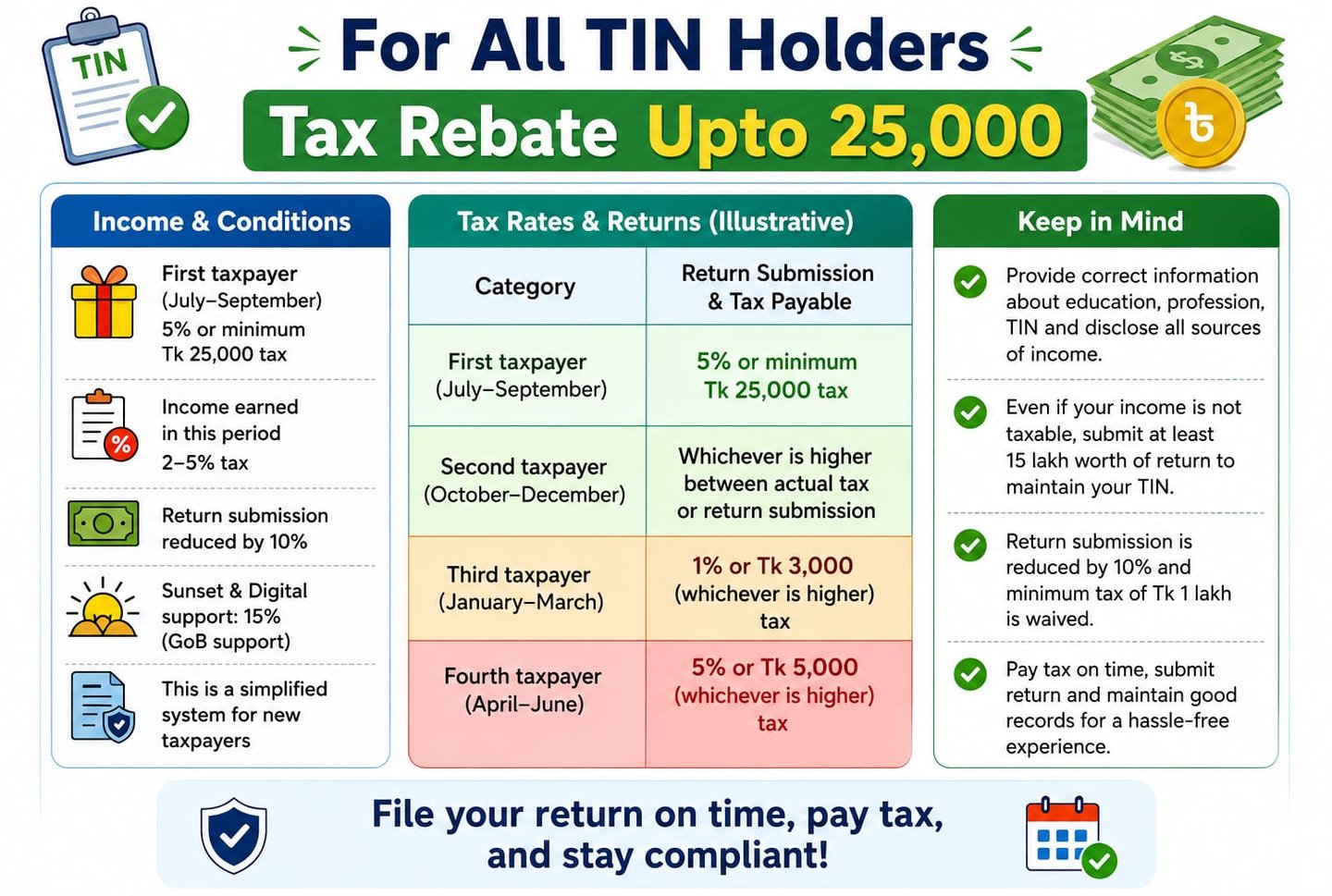
Filing your income tax return during the First Quarter (July to September) is highly recommended. Not only do you protect your approved investment tax credits, but you also receive an instant 5% direct waiver on your total payable tax, capped at BDT 25,000. Delaying past September means losing your investment tax credits entirely!
1. The Four-Quarter Tax Return System & Timelines
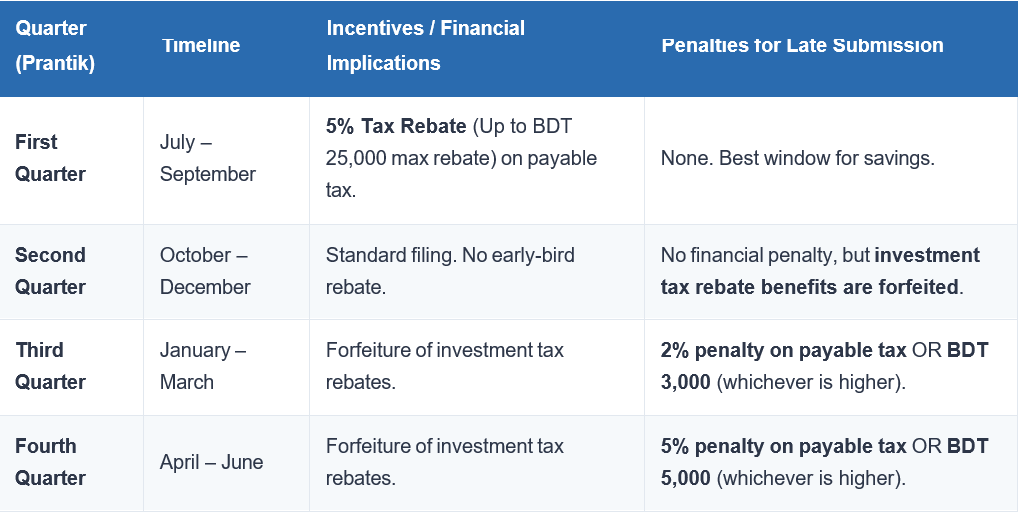
Previously, individual taxpayers were bound to a fixed tax day, typically November 30th, often leading to server crashes, long queues, and arbitrary deadline extensions. Under the newly proposed system, taxpayers can file their returns at any point during the fiscal year. However, your filing timeline directly determines whether you receive a tax discount or face heavy penalties.
The financial year is divided into four quarters, mapped out with specific rules:
2. Reduced Tax Rebate on Investments
For years, traditional investment instruments like National Savings Certificates (Sanchayapatra), life insurance premiums, and Provident Funds (DPS) have been the go-to mechanisms for middle-class taxpayers to lower their tax burdens. The new budget introduces a tighter ceiling on these standard tax exemptions.
• Previous Rule: Taxpayers could enjoy a tax rebate of up to 15% on their eligible investments, or up to a maximum investment cap of BDT 10 Lakhs.
• Proposed Rule: The maximum investment tax rebate rate has been scaled down to 10%. Furthermore, the maximum ceiling for allowable investments has been reduced from BDT 10 Lakhs to BDT 7.5 Lakhs.
This means taxpayers will have to pay higher net taxes on equivalent incomes compared to previous years,as the allowable cushion for traditional tax-saving investments has shrunk significantly.
4. Mandatory BIN for 7 Core Commercial Services
To curb tax evasion and broaden the Value Added Tax (VAT) network, the revenue authority is making the Business Identification Number (BIN) absolute mandatory for seven key economic sectors. Businesses operating within these services can no longer run solely on a TIN certificate; they must obtain and display a valid BIN to comply with licensing laws:
1. E-commerce platforms and online retail businesses
2. Boutique shops, fashion houses, and tailored clothing brands
3. Sweets, bakeries, and specialized confectionery shops
4. Catering services and event management companies
5. Commercial printing presses and publishing houses
6. Community centers, convention halls, and rental spaces
7. Coaching centers, private educational consultancy hubs, and training institutions
5. Accelerated Tax Refunds within 60 Days
While the new framework enforces stricter penalties for non-compliance, it also brings a highly anticipated relief for taxpayers who accidentally overpay. Historically, claiming a tax refund from the NBR required arduous paperwork and months of bureaucratic follow-ups.
Under the automated updates, if a taxpayer pays excess tax through source deductions (AIT) or advance tax payments, the government is legally mandated to process and deposit the excess amount directly into the taxpayer's designated bank account within 60 days. This automated refund tracking system aims to foster a friendlier relationship between the state and individual taxpayers, motivating voluntary disclosures.
Conclusion: Transitioning to a Digital and Transparent Ecosystem
The primary objective of these sweeping changes is clear: transitioning Bangladesh's tax infrastructure into a fully digitalized, transparent, and predictable model. By introducing automated 60-day refunds and lucrative early-bird waivers, the government is incentivizing voluntary compliance.
At the same time, by shrinking investment exemptions, taxing digital/gold assets, and slapping multi-tier penalties on late filings, the state is clamping down on delayed and incomplete filings. To safeguard your finances and maximize your savings, mark your calendar for the July-September filing window and ensure all your high-value assets are documented accurately.
Get in touch
Address
Flat- 2B, House-19, Road-14, Sector-13, Uttara, Dhaka-1230
Contacts
+880 1681 822497 +880 1700 858892
Emails
info@taxorabd.com contact@taxorabd.com su.akash290@outlook.com
______________________________________________________________________________________________________________________________________
(c) All Rights Reserved by - Taxorabd